Site
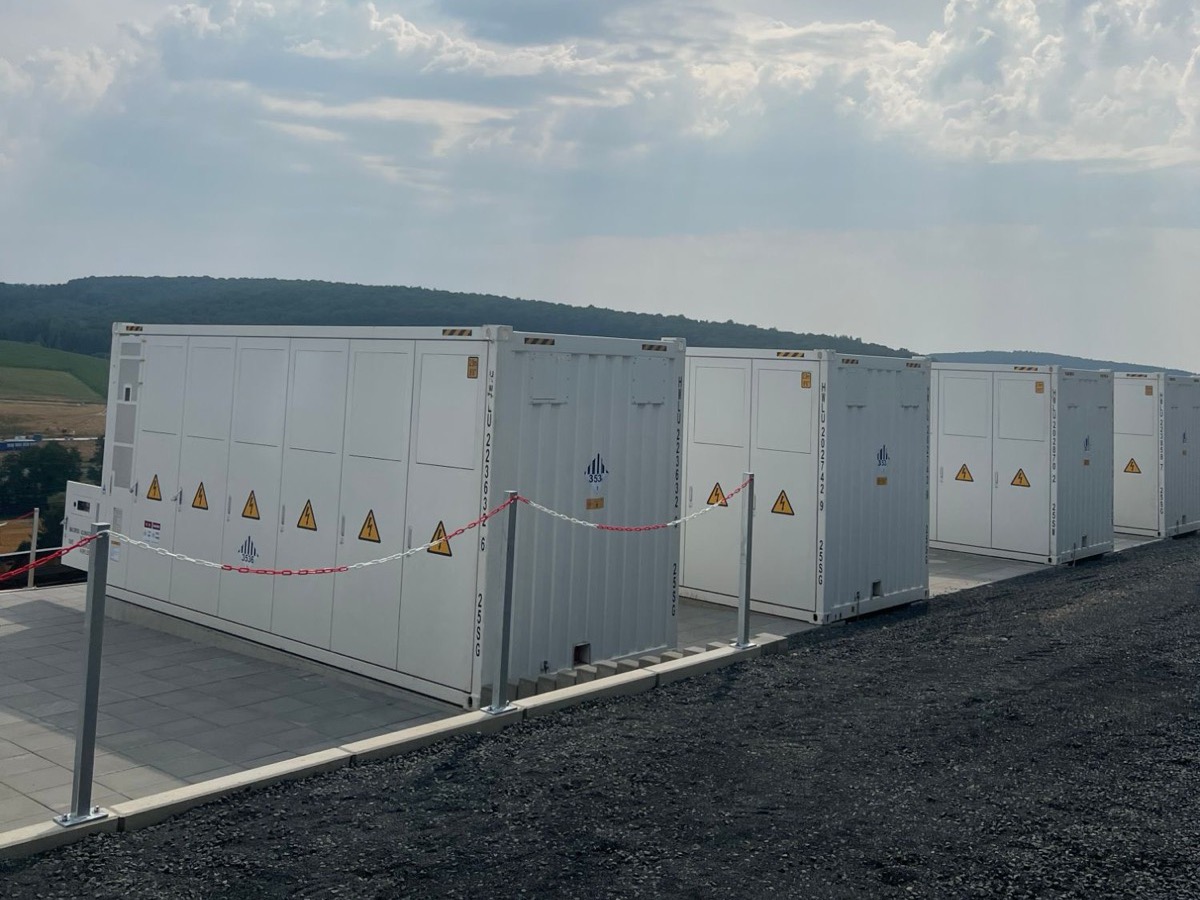
The site lies in the Heining cadastral district within the city of Passau, on a land parcel with an existing ground-mounted solar plant.1 The land is secured and its geometry allows the storage containers and a transformer station to be placed without touching the existing module area.
The existing plant has been feeding into the local distribution grid for years under a fixed feed-in tariff. That is precisely where the interesting question of this project arises.
System design
The design follows the purpose: two hours of discharge at full power, a C-rate of around 0.45. That is an arbitrage design, not a balancing design.
| Item | Figure |
|---|---|
| Discharge power | 2 MW, with headroom1 |
| Storage capacity | 4.472 MWh1 |
| Cell chemistry | lithium iron phosphate |
| Existing generation | ground-mounted solar, 565 kWp1 |
| Connection level | medium voltage, VDE-AR-N 4110 |
| Operating mode | Arbitrage on the day-ahead and intraday markets, absorbing curtailed solar output |
| Marketing | through a specialised direct marketer with a connected energy management system |
We name component manufacturers once they are ordered. Until then any figure would be an intention, not a fact.
One connection, two plants
Grid and regulation
Because both plants use the same connection point, the accounting split determines the economics. If the storage charges subsidised solar power and discharges it later, the question is which share remains eligible for support and which counts as grid power.
The Federal Network Agency's MiSpeL determination answers this. It introduces a demarcation option for mixed-use storage and is due to enter into force on 1 October 2026, with transitional rules.2 For this project that means the design is chosen so that it holds under both regimes — before and after the date.
The second open item is the construction cost contribution. Since the Federal Court of Justice decision of 15 July 2025, distribution operators may charge it on battery storage as well, calculated under the capacity price model.3 Its amount is fixed only with the connection offer and feeds directly into the financial model.
Stage reached
Land is secured and the system design is complete. The grid connection request is in preparation. Nothing beyond that has been reached — and nothing beyond that is claimed here.
Timeline
Evidenced steps only. Planned dates appear here once a contract or a procedural status supports them.
System design completed
Power, capacity, layout and connection concept defined; economics calculated on historical day-ahead prices.1
Land secured
Right of use over the parcel agreed by contract, including cable rights and access.
Grid connection request
Submission to the responsible distribution operator. The date depends on the final alignment of the connection concept.
Frequent questions
Why only 2 MW? That is small for a grid-scale plant.
Because the existing connection point sets the limit. A plant exceeding the available connection capacity needs either grid reinforcement or a flexible connection agreement under section 17(2b) EnWG. Both are possible and both change the economics — which is why it is calculated before the power rating is fixed.
What happens to the feed-in tariff of the existing plant?
Has the project already been sold?
No. For a project of this size both a sale at ready-to-build and operation on our own books are open options. The decision falls with the grid connection offer, because only then can the revenue side be modelled robustly.
Sources
Sources last reconciled on
- Brave Power Group (damals Sunbrave Energy), Projektüberblick: Project overview storage Passau-Heining, as of July 2025. As of 2025-07.
- Bundesnetzagentur: Determination procedure on market integration of storage and charging points (MiSpeL), ref. 618-25-02. As of 2026-08-05. Go to source
- Bundesgerichtshof: Press release: Federal Court of Justice approves construction cost contribution for battery storage (decision of 15 July 2025, EnVR 1/24). As of 2025-07-15. Go to source